A vector is a line in space. It has a direction and a magnitude (its length.) A common example of a vector's usage is in keeping track of the velocity of a physical body:
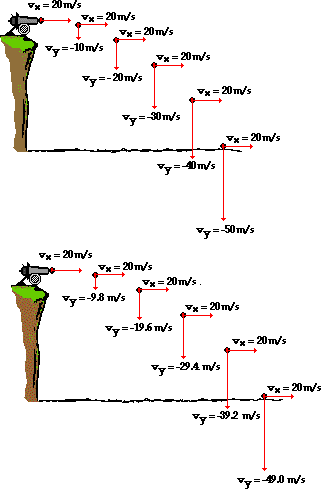
Note that in the above diagram, the vector's components (x and y separately) are shown. The actual vector can be found by adding its components. You'd end up with a line pointing in the exact direction the cannonball is moving, with the length of the line showing its exact speed.

Vectors are used for normals as well as velocities. A normal describes the "angle" of a flat surface by pointing directly away from it. The normal of your desk is a line pointing straight up. The normal of the hood of your car points up and forwards a little (assuming that your hood is closed and we only have to deal with one side of it.) Typically, the magnitude (length) of a normal is 1, because its magnitude is not important. A vector with a magnitude of 1 is considered "normalized."
Note that in the above diagram, the vector's components (x and y separately) are shown. The actual vector can be found by adding its components. You'd end up with a line pointing in the exact direction the cannonball is moving, with the length of the line showing its exact speed.
Vectors are used for normals as well as velocities. A normal describes the "angle" of a flat surface by pointing directly away from it. The normal of your desk is a line pointing straight up. The normal of the hood of your car points up and forwards a little (assuming that your hood is closed and we only have to deal with one side of it.) Typically, the magnitude (length) of a normal is 1, because its magnitude is not important. A vector with a magnitude of 1 is considered "normalized."